
The Temperate Deciduous Forest: Predatory/Prey Relationship


Alyssa Nucci
AP Biology-4


The Temperate Deciduous Forest:
Predator/Prey Relationship 
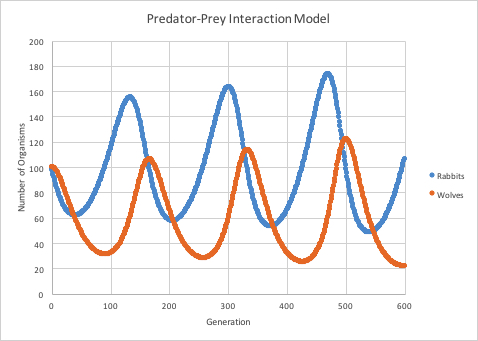

       It is given that predators influence the population of their prey. However, it is shown here that conversely, prey affects the number of predators. As the number of prey drops, so does the number of predators, due to a now limited food supply. Here is an example of a common predator/prey relationship in the Temperate Deciduous Forest: Wolves and Rabbits. As the number of wolves decreases, in turn the number of rabbits begins to increase again, eventually increasing the number of wolves. This cycle can repeat indefinitely as long as the predator and prey populations remain. 


“Predator-Prey Interaction .” Predator-Prey Interaction, www2.nau.edu/lrm22/lessons/predator_prey/predator_prey.html.

Comments

Popular posts from this blog

The Temperate Deciduous Forest: Keystone Species

Alyssa Nucci  AP Biology-4 The Temperate Deciduous Forest: Keystone Species        Keystone species are organisms within an ecosystem in which other species largely depend upon, furthermore upholding the sustainability of the ecosystem. In the Temperate Deciduous Forest biome,   a keystone species is the white-tailed deer. This is because their feeding activity can affect many plants and animals in the surrounding environment. White-tailed deer thrive best in forests with biodiversity. In the spring and summer seasons, these deer eat grasses, wildflowers, mushrooms, and woody plant leaves. As fall begins, the deer gravitate towards acorns, fallen fruits, and crops. In winter, deer eat woody vegetation such as twigs, bark, and foliage.         Deer are preyed upon by wolves, coyotes, bears, bobcats, and humans. As prey, their carcasses can sustain other organisms in their environment such as eagles, ravens, crows, etc. D...

The Temperate Deciduous Forest: Population Growth

Alyssa Nucci AP-Biology The Temperate Deciduous Forest:  Population Growth  Exponential Growth:         Exponential growth is growth where the rate increases faster than the growing total number or size. This type of growth occurs when a population is increasing without any limiting factors. An exponential graph rises in a "J" curve from the lower left to the upper right. In the Temperate Deciduous Forest, an example of an organism of exponential growth is bacteria. In this biome, the medium provides the nutrients necessary for bacteria's growth. There are four stages to the exponential growth of these bacteria. Once bacteria enter the ecosystem, there is a period of time called the lag phase, where the population size remains constant. Next comes the log phase, where cell numbers increase in an exponential growth pattern. This phase continues until nutrients are expended, causing the cell growth rate to sl...

The Temperate Deciduous Forest: Primary and Secondary Succession

Alyssa Nucci  AP Biology-4 The Temperate Deciduous Forest:  Primary and Secondary Succession         Primary Succession occurs in areas where the soil is incapable of sustaining life.  Primary succession begins in desolate areas, first inhabiting lichens or plants that can survive in such an environment. Over hundreds of years, these species convert the environment into soil that is able to sustain simple plants like grasses. These grasses further modify the terrain, and once the soil has eventually reached its optimal richness, other plants can grow and thrive as well. An example of primary succession in the Temperate Deciduous Forest biome is lichens. Lichens are found in these barren areas and are able to give off acid which will degrade the rock present into soil. Once there is soil, moss grows and adds nutrients into the soil. Grasses are now able to form as the soil thickens, eventually providing a home for bushes ...